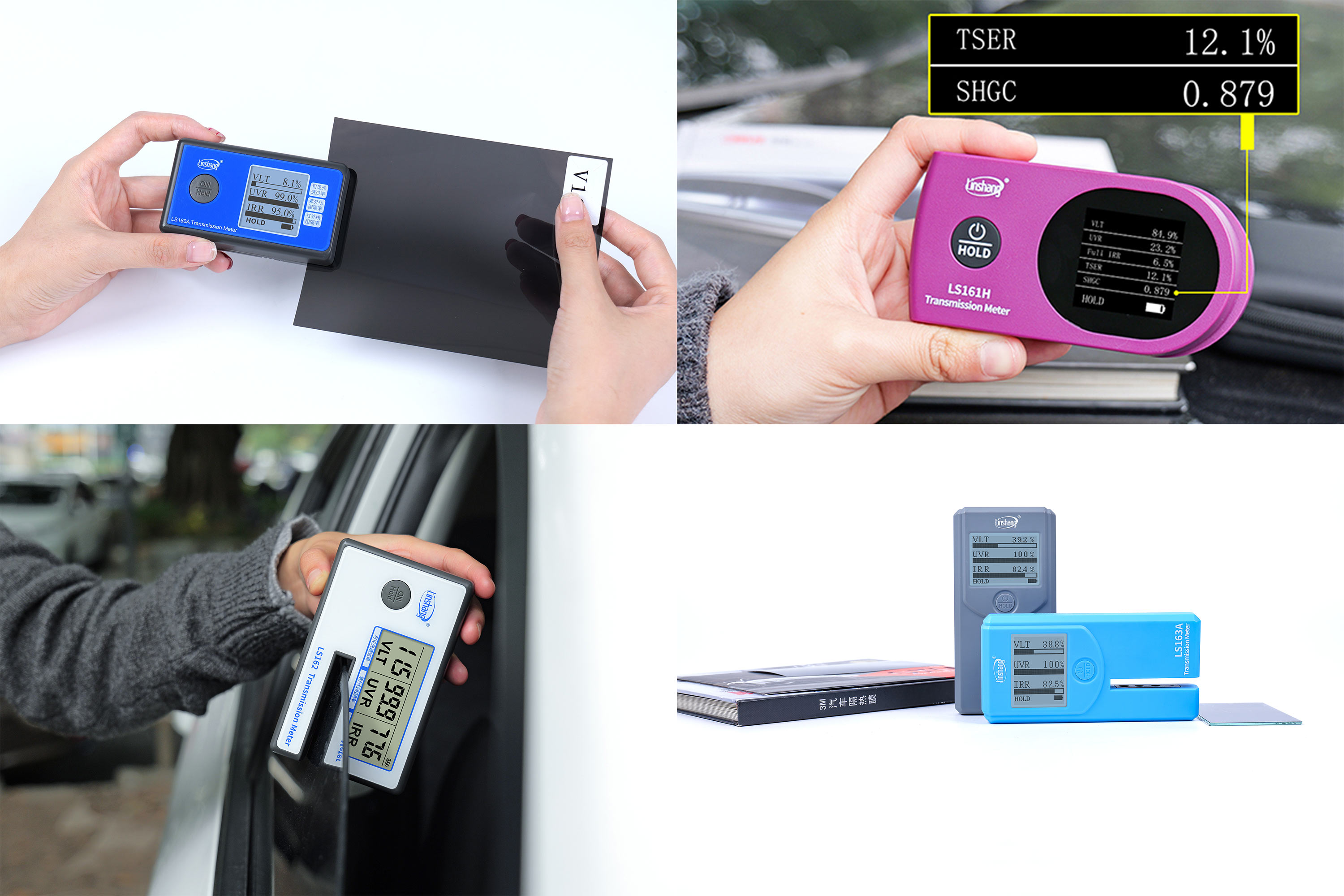
Portable Window-tint Transmission Meter
As a manufacturer of portable solar film test instruments, Linshang Technology provides you with a series of portable solar film test instruments, including four series: LS160, LS161, LS162, and LS163, which can measure the transmittance of infrared rays in the 940nm and 1400nm bands, visible light transmittance, TSER, SHGC and other parameters. Linshang solar film tester can test both thin films and filmed glass or car side profiles. It has a digital display and accurate and convincing test data, making it a useful tool to assist you in selling automotive solar films.

LS160 Transmission Meter
Small size: 93 *52*25mm(L*W*H), 65g (include batteries)
VL Peak wavelength: 530nm;UV Peak wavelength: 365nm
IR Peak wavelength: 940nm
Portable product for transmission value measurement.

LS160A Transmission Meter
Small size, 93*52*25mm(L*W*H), 65g (include batteries)
VL Peak wavelength: 530nm, UV Peak wavelength: 365nm
IR Peak wavelength: 1400nm
Portable product for transmission value measurement.

LS161 Transmission Meter
Color screen display, more intuitive
Freely switch between multiple display modes
Simple operation and fast measurement
IR Peak Wavelength: 940nm

LS161A Transmission Meter
Color screen display, more intuitive
Freely switch between multiple display modes
Simple operation and fast measurement
IR Peak Wavelength: 1400nm

LS161H Transmission Meter
Tests 7 parameters: UV, Visible Light, IR 940 nm, IR 1400 nm, Full-IR, TSER, SHGC
Easily switch between multiple display modes
Suitable for solar film performance demonstration, production, quality inspection, and other applications

LS162 Transmission Meter
Simple operation and backlit LCD display.
Measure VLT of 380-760nm, UV 365nm, IR 940nm.
Measure films/glass up to 8mm.

LS162A Transmission Meter
Measure VLT of 380-760nm, UV 365nm, IR 1400nm.
Allows for single hand operation, backlit LCD display.
Measure films/glass up to 8mm.

LS163 Transmission Meter
Measure UV 365nm and IR 940nm, visible light transmittance
Resolution reach 0.1%, rotatable display
Using parallel optical path design for testing thick materials
Display light transmittance or rejection rate

LS163A Transmission Meter
Test seven parameters: visible light, UV, IR 940nm, IR 1400nm, Full-IR, TSER, SHGC
Multiple display modes are available for free switching
6mm test slot supports testing of thick materials
I. How to select a suitable portable window tint transmission meter?
| Model | IR peak wavelength | UV peak wavelength | Visible Light | SHGC/TSER | Test Slot Width |
| LS160 | 940nm | 365nm | 530nm | × | <0.8mm |
| LS161 | 380-760nm (conform to CIE photopic luminosity function) | ||||
| LS162 | <8mm | ||||
| LS163 | <6mm | ||||
| LS160A | 1400nm | 530nm | <0.8mm | ||
| LS161A | 380-760nm (conform to CIE photopic luminosity function) | ||||
| LS162A | <8mm | ||||
| LS163A | <6mm | ||||
| LS161H | 940nm 1400nm Full-IR |
√ | <0.8mm |
II. Which test result is more accurate between window tint meter with 940nm and 1400nm light source?
No matter which window tint meter is used, the test data is objective and accurate.The two wavelengths of 940nm and 1400nm are relatively representative wavelengths of sun spectrum.
Most of the absorbing films (heat-absorbing films) have better infrared blocking effect at 940nm, while the magnetron sputtering reflection film has better blocking effect at 1400nm such as metallic film and ceramic nano window film.
III. What are SHGC and TSER?
SHGC (Solar Heat Gain Coefficient) and TSER (Total Solar Energy Rejected) are two key performance indicators used to evaluate the ability of glass or window films to control solar energy.
SHGC (Solar Heat Gain Coefficient): Represents the total amount of solar energy transmitted through glass or window film. It ranges from 0 to 1, where a lower value means less heat enters, resulting in better heat insulation.
TSER (Total Solar Energy Rejected): Indicates the percentage of solar energy blocked by the window film or glass and is calculated as 1 - SHGC. For example, if the SHGC is 0.3, then TSER = 1 - 0.3 = 70%, meaning 70% of the solar energy is blocked, and only 30% enters.
These two metrics are crucial for evaluating energy efficiency, heat insulation, and overall comfort in both automotive and architectural applications.
IV. Why measure SHGC/TSER with a window-tint transmission meter?
A portable window-tint transmission meter is mainly used to measure the optical properties of window films or glass. Some advanced models such as LS161H also support SHGC and TSER testing, which is beneficial in several areas:
-
Automotive Window Film Industry
a. Car owners and professional tint shops can use a window tint tester to measure the heat rejection performance of window films, ensuring they get high-quality products instead of misleadingly advertised films.
b. By testing SHGC/TSER, users can determine how effective a film is at blocking heat, making it easier to choose a suitable tint, especially in hot climates.
-
Architectural Glass Industry
a. Glass manufacturers and construction companies use SHGC/TSER data to evaluate the heat insulation performance of architectural glass and ensure compliance with energy efficiency standards.
b. Certifications often require SHGC data to assess a building’s thermal performance.
-
Regulatory Compliance & Law Enforcement
Some regions have regulations on SHGC/TSER limits for automotive window films. A portable window tint meter allows law enforcement officers to quickly verify whether a vehicle’s tint meets legal requirements.
V. How to use a portable window-tint meter?
Using a Linshang portable window-tint meter is incredibly simple. Designed for quick and accurate window tint testing, it requires no complex setup—just insert the material and get instant readings. This feature makes it perfect for automotive professionals, inspection agencies, and window tint installers who need fast and reliable results.
● Step-by-Step Guide to Measuring Window Tint
Power on the device: Press the button to turn on the portable window tint meter.
Insert the window film: Place the tinted glass or window film into the testing slot. The device will automatically detect the material and begin measurement.
Lock the data: Press the button again to hold the value for easy reading.
VI. Why choose Linshang portable window-tint meter?
Linshang Technology has 17 years of expertise in solar film testing, ensuring our portable window tint meters provide accurate, reliable, and user-friendly solutions for professionals and consumers alike.
Simple operation: Just insert the material, and the data is displayed instantly.
Provide kinds of types: A variety of models are available to test both films and window glass.
Light and powerful: LS161H only 70g, but it can measure seven parameters: VLT, UV, IR 940nm, IR 1400nm, Full-IR, TSER, SHGC.